Explained
Astigmatism (cylinder): why your eye is not a football
Last updated: 20 August 2026
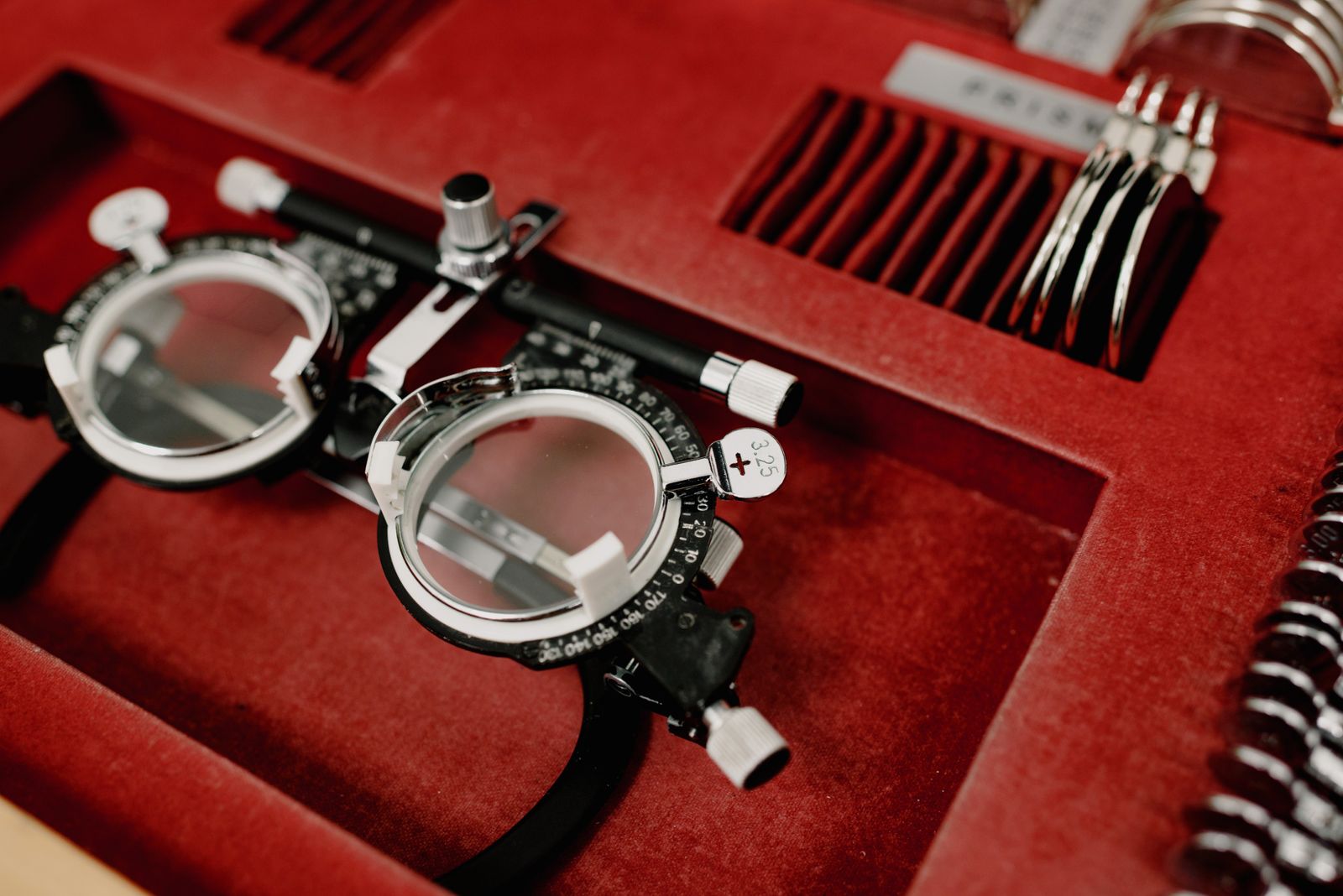
Next to the power on your prescription there is suddenly a 'cylinder' and an 'axis'. Astigmatism, says the optician. It sounds like a disorder, but it is mostly a matter of shape — and one of the most common, most correctable traits of the human eye. Here is what those numbers mean.
In short
- In astigmatism the cornea (or lens) is not evenly curved: more rugby ball than football.
- Light is bent differently in two directions: the image is smeared or ghosted, far and near alike.
- On the prescription: CYL (how much cylinder) and AXIS (in which direction); nearly everyone has a little.
- Correction works well: with spectacle lenses, toric contact lenses and usually laser surgery too.
⚠ Acute symptoms?Sudden vision loss, an eye injury, chemicals in the eye, severe pain, or new blind spots in your visual field? Don't wait for an online explanation — call your GP (huisarts), the out-of-hours GP service, or 112 immediately.
The football and the rugby ball
A 'perfect' eye has a cornea curved equally in all directions, like the surface of a football. Light is then bent equally in every direction and converges neatly in one point. In astigmatism the curvature is stronger in one direction than the other — think of the side of a rugby ball or a spoon. Light passing through such a surface is focused differently in two planes: two focal points instead of one, and a smeared image on the retina.
Important to know: astigmatism is not a disease but a shape variant. Hardly anyone has a perfectly round cornea; a small cylinder is the rule rather than the exception.
What do you notice?
Unlike near- or farsightedness, astigmatism disturbs at all distances. Typical: edges that are never quite crisp, letters that 'ghost' or double (especially thin letters and digits), lights fanning out into streaks or stars at night, and eyes that tire faster because they keep hunting for a focus that does not exist. With a small cylinder you often notice nothing; with larger ones the image gets noticeably messier.
CYL and AXIS: the two numbers on your prescription
Correcting astigmatism needs two coordinates. CYL (cylinder) says how much extra power is needed in one direction, for example -0.75 or -1.50. AXIS says in which direction that extra power must sit, in degrees from 0 to 180 — like the position of a hand on a protractor. That is why a cylinder lens must sit precisely aligned in the frame, and why toric contact lenses carry a small weighting that keeps them in position.
Two prescriptions with the same cylinder but a different axis are therefore genuinely different glasses. A small axis shift between measurements is normal; the eye is not a machine.
Where does it come from, and does it change?
Astigmatism is usually congenital and familial, and stays fairly stable for life. It can drift slowly, and lid swellings, chalazia or eye surgery can temporarily 'mix in' cylinder. One exception deserves its own paragraph: a cylinder that increases rapidly at a young age, keeps tilting and corrects poorly can point to keratoconus — a thinning of the cornea we cover in a separate article. That is exactly why repeat measurements matter in young people with a lot of cylinder.
How is it corrected?
Spectacle lenses with cylinder are the standard and work excellently. Contact lenses too: toric soft lenses for most powers, and rigid gas-permeable lenses that effectively override the corneal surface — often the sharpest solution for higher or irregular cylinders. Laser surgery can correct astigmatism up to considerable powers, and during cataract surgery a toric artificial lens can take the cylinder along in one go. In short: for virtually every cylinder there is a tidy solution.
Frequently asked questions
I have 'only' -0.50 cylinder. Should I have it corrected?
Not necessarily. A small cylinder without complaints can happily be left alone. Correction becomes interesting once you have matching complaints: ghosting edges, tired eyes, bothersome night vision.
Can screens cause astigmatism or make it worse?
No. Screen work can tire eyes and dry them out, but does not change the shape of your cornea. Astigmatism is build, not wear.
Why do I see streaks around lights at night?
In the dark your pupil is wide, so light also passes through the outer, most 'deviant' parts of your optics. Cylinder blur then becomes extra visible as fanning light. Well-corrected glasses often make a clear difference.
My axis changed from 85 to 95 degrees. Is that worrying?
Small axis shifts between measurements are normal and partly within measurement margin. Large or fast changes, certainly with increasing cylinder at a young age, are a reason to have the cornea mapped.
Sources and further reading
This article is general explanation, not medical advice about your situation. For acute symptoms: call your GP, the out-of-hours GP service, or 112.